Showing posts with label Health Promotion. Show all posts

August 10, 2015

SUGAR

I love sugar. Love love love it. Give me fruit, give me gelati, give me cake, give me pie, give me milkshakes and slices and lollies oh my! But lately, sugar has been getting a bad rap, as we look at our battle with the bulge, some people have sugar in the firing line. Last week, I watched two documentaries about sugar and health.

The first was the much talked about 'That Sugar Film'.


There has been a lot written about this film by people far cleverer than I so I won't harp on about it. There was some things I liked in this, and some I didn't.  Bottom line: if it gets people thinking and talking about their diets, it's great, but casting sugar as the devil in this piece is perhaps a little one dimensional - little time was given to the dangers of excessive salt or fat in our diets. More time could also have been given to the importance of exercise, and making a stronger definition between naturally occurring sugars and added sugars. I think this documentary sits well among other health information (and I am not talking about self proclaimed experts on Facebook) - because while I am sure experts were consulted on this project and informed the development - it was a study of one, conducted by a television actor, and has virtually zero external validity, given the number of confounding variables in this 'study'. But as I say, starting the conversation is part of the battle, and this is a good thing.

The second was 'Fat V Sugar' (Click this link to watch it all online for free in the next seven days)


Again, there have been many things written about this documentary. Since it is not as well known, the basic premise is that a set of twins, adult doctors as it happens, decide to undertake one each of a fat or sugar loaded diet and monitor the effects they have on the body, in much the same way as That Sugar Film does. Long story short: both men have poor health outcomes. And while again, this study has no repeatability, and has too many variables to make it a legitimate study, they presented two sides of the diet debate, and had an excellent, if boring, bottom line.

Everything in moderation.

I know I know how revolutionary. And how boring! Why can't I just cut one food out of my diet and be skinny! Why can't I eat this instead and it is a miracle food which does everything else I need! This is the thing - we want a quick easy fix. I'll quit sugar and I will be healthy! I'll start eating kalettes and my internal health will be amazing! But it doesn't work like that, moderation is key. Extreme diets where all food groups are cut out (unless you have a medical reason, of course!) are unsustainable.

And this is the other problem.

When we use the word diet, it can mean two things. It can mean, "I'm going on a diet where all I eat is lemon tea and acai berries" or it can mean "I enjoy a well balanced diet 365 days of the year". We need to get away from yo-yo diets and fad diets and losing 10 kilos so we can be bikini ready and looks at making our 365 diets more well rounded and sustainable. Make little changes here and there, don't bother with cheat days - keep it rocking all the time, and never get yourself to a point of excess for any food. Don't eat a whole bag of chips or block of chocolate. Just don't. Try and bring some more whole grains (I am doing this, I hate it, but I am doing it), try to bring in more greens (Helllooo spinach in everything) - but don't cut all carbs, and only eat salad - and try drinking less soft drink.

Which brings me to my final point.

Label reading is IMPORTANT. But not all the time - just be aware. A few weeks ago, before I watched either of these documentaries, Steve and I were in the supermarket shopping for the dinner we were cooking for family. As I said above, I have made small changes - one of them is cutting back (not quitting) sugary drinks. I didn't drink a lot, but I felt it was something I could do less of. We decided we would buy mineral water instead of soft drink, because it's healthier, right? Well! This is what we found.
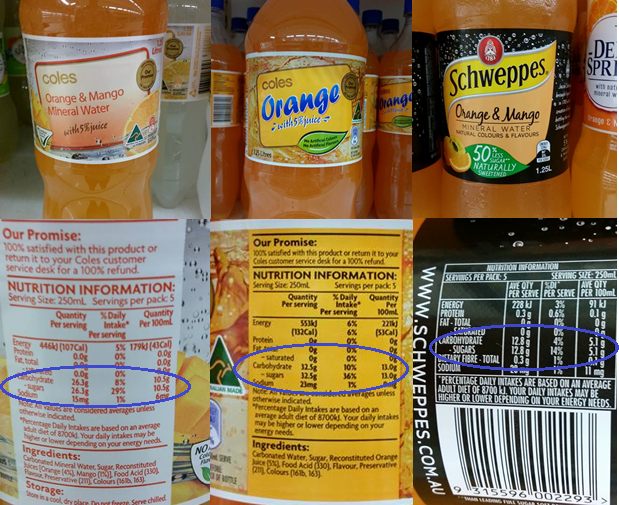

Can you see that? You might not be able to. The Coles Mineral water - which I grabbed first based on price, has 10.5 grams of sugar per 100mls. For some reason, I decided to compare this to the same flavour in the soft drink. It's 13 grams per 100mls. Only 2.5 more grams! I was flabbergasted at this. These are both fine products (don't sue me Coles), but if you are looking at sugar, there was little difference. I then looked at the Schweppes brand and true to the label advertising less sugar - which I often ignore as a simple marketing ploy - it has 5.1 grams of sugar per 100ml. Whoa. Bet you can guess which one I picked.

So what is my bottom line? Well, I am just another flog on the internet. I don't know it all, and there are things I struggle with, but I think moderation is honestly key, and maintaining a constant diet always is better than yo yo-ing, and if you can do anything to cut back realistically on your excess sugar, fat and salt intake, then do it!

Adios bloggers!

July 13, 2015

Corporate Sponsorship and our Children's Food and Exercise Habits

Hey bloggers!

How are we? As I shared on the Facebook page last week - I went for a job annnnnd didn't get it! BUGGER! My feedback was the same as the previous interview - we loved your energy and enthusiasm but in this instance, we had a more qualified applicant (5+ years). Ack, much graduate, so hard.


But, on we press! This little train that could is powering through the stations 'disheartening-ness' and 'fear of failure' and pressing on through to the stations 'success' and 'joyousness'. What helps this is that I have been awarded with the Penfold Prize for Public Health at La Trobe University for having the highest average mark for 3 Public Health units - see, I told you this girl loves Public Health!

So, for this weeks consideration, and sort of following on from last weeks post, is what place do big corporations have in our children's food and physical activity industries? (Note: I don't have a kid, just an awesome fiance and cat).

What I mean by this is two different things: First, food companies that are typically unhealthy - sponsoring kids sport, such as the McDonalds sponsorship of the Hooptime kids basketball competition, and formally of Auskick. This week I'm going to leave a lot of thinking up to you, internet, but here are some starters... what sort of message does it send to kids to associate physical activity with energy dense nutrient poor foods. Or where would these sporting organisations be without the huge corporate sponsorship they currently receive; would they disappear and would this lead to obesity as well, as there isn't enough money to run the programs?

Worth thinking about.

This is the other thing to think about. What about children's character 'endorsement' of certain foods? Characters like Mickey, Hoot, Peppa, Minions etc have a lot of influence in the lives of their key demographic. So why are the organisations behind the corporate endorsement of foods choosing foods that aren't particularly healthy? My assessment of this today in one supermarket: Minions are currently appearing on Tic Tacs, Cupcake mixes and Banana flavoured biscuits, none of which children need any help in consuming - why aren't they sponsoring actual bananas (prepacked), or healthy breakfast cereals (Oats or Wheetbix!) As an example here are more of the products Minions currently appear on.... not a lot of food kids should be encouraged to eat!


As this post is designed for you to think about, all I really want is for people to be aware of how this is all affecting our food and exercise and to think critically about it! Are these things you have noticed too? Should we be looking at who is supporting kids food and sporting competitions? Or is that just the way it is? 


July 06, 2015

Who runs the world? Girls! Who run this mutha? Oh it's actually huge multi-national countries.

In both of my current jobs, I spend a lot of time in supermarkets and shopping centres. Like many people, I check out the specials before I go shopping and it is genuinely starting to freak me out how much of it is unhealthy food, and beyond that, that many (most, even?) of the products in supermarkets are owned by some of the same half a dozen companies.

What do I mean by this? Well, sure, Nestle make baking chocolate and condensed milk but they also own the brands Maggi, Uncle Tobys, Nespresso and Purina! Then you turn over a packet of Dove soap and you see it is made by Unilever and sure sure I've seen that before but did you know Unilever also own Lipton, T2 and Bushells Tea, Omo washing powder and Ben and Jerry's. It is, in fact, increasingly difficult to support independant and local brands when shopping at a supermarket. To see more of what I am talking about, have a look at the diagram below.


I just find this super interesting. And I think it opens up a lot of questions like...
Where is my food being produced (See the Nannas berry saga to see why this is an issue!)
How far has this food travelled to make it to me and how much damage did this do to the environment to get here in terms of petrol used?
How much time has this spent in transit, and what chemicals and preservatives (and food dyes and their origins) did they use to get it here looking like this?

These are questions that you don't need to ask when you are buying from smaller, local companies - and there is believed to be a lot of health benefits from eating local in-season produce - but this is next to impossible in this day and age. And it's not all bad, some of these companies sponsor local events and fundraising... but I think it is interesting to think about. It also makes a point about why it's best to use a simple method when shopping for healthy groceries in a supermarket:

Stick to the outside of the supermarket.

This will include fresh fruit, vegetables and meat etc, whereas typically, the aisles are filled with these highly processed foods that are owned by large multi-nationals.

But I digress. the most interesting company to look at is Altria.


Who is Altria? Well, they have a generic colourful logo which gives no indication as to what they actually do. And they own a lot of companies, like the big multi-nationals I listed above. Their big ticket item is a little company called Phillip Morris who are the dead set legends* behind Marlboro cigarettes.

Let's look deeper. Altria own more than 28% of SABMiller. SABMiller own ALL of Fosters, who we know as the makers of popular brands VB, Carlton Draught, Pure Blonde, Cascade, Miller and Chill. So. This means that whenever you enjoy one of these beverages, 28% of it is owned by Altria who will be funneling that money into continuing the sale of cigarettes.

Now... its important to remember that these companies give people jobs and that is incredibly important to health. But wouldn't it be better if these companies put the amount of effort  and money they do into making us unhealthy...into making us healthier instead?

So what are my key points?

Shop local. Don't shop highly processed foods. Think about where your food comes from and what it goes through to get to you. Support smaller independent breweries! Don't bloody smoke! And remember that no one is perfect and while it's fine to say all this, it's near impossible to remain a 100% ethical human being in terms of food and drink! But it's good to know and be able to make informed decisions!

Over and out!


*Uh, not really. I have other words for them. Ask me in person. What sort of company sells a product which will kill you in a horrific way, or produces a product that the picking of can lead to illness in children in the developing countries where tobacco is grown and young children work, or what sort of company aggressively advertises their death-inducing products to developing nations with little knowledge of the health ramifications but annnywayyyyy....

June 29, 2015

Organ Donation

A few years ago, I signed up to be an organ donor. I even said they could take the piano.

Image result for basil brush

Welcome, to those of you who are new to my lame puns and public health interests. Today I am talking organ donation. If you can't be bothered reading ahead, here is my argument:

Australia needs to adopt an Opt-out (Or presumed consent) stance on organ donation, and my reason is thus: you don't need your organs once you are dead. Blunt, but 100% accurate.

In Australia, somewhere around 1500 people are on organ donation waiting lists at any time. This could be your Mother, Father, Sister, Brother, Cat or Dog, or your entire Facebook friends list....several times over in my case. A single person donating their organs, if viable, can change up to 10 peoples lives, and in 2014, 378 viable donors were able to save the lives of 1117 fellow Australians. That still leaves a shortfall of around 400 people and that's just lousy.

The tricky thing with organ donation is that not everyone who is signed up to be an organ donor will have a viable death, that is, the most viable organs are harvested from those who are declared brain dead - but whose other organs are still working. Often, this means that the most viable donors need to already be in hospital in their final stages of life, as the use of ventilators to keep oxygen to the blood and therefore the organs is critical. Many people with long term illness are not treated in hospital, as they may prefer to stay in their homes, and most without long term illness who find themselves in a fatal situation will be no-where near a hospital when the time comes - getting these people to a hospital in their dying moments so they can have their organs donated isn't always feasible or even possible.

It is for this reason that we need to maximise the number of people who are even organ donors in the first place, so that we are maximising the potential number of donors.

There are a number of countries in the world who have adopted opt-out or assumed consent method -which works by saying ' You are an organ donor. Unless you tell us you don't want to be' rather than the current opt-in situation in Australia where it is a case of 'You are not an organ donor. Unless you get around to filling in some forms to tell us that you want to be when you already have a pretty busy life and really it's not something you want to think about right now so maybe I will just leave it for a bit'.

A quick Google tells me that Israel has a funky system whereby if you are signed up to be an organ donor, and you require medical treatment, you will get preferential treatments over someone needing treatment who isn't a donor! Yay organ donors!

Wales brought in assumed consent in 2013!

Austria, Belgium, Croatia, Hungary, Luxembourg and Slovenia all have presumed consent!

Like what seems like a lot of things at the moment, Australia is dragging its arse on this topic, and I suspect this is for political reasons; too many politicians are afraid to bring controversial things to the table for fear of losing political seats.

There is one potential barrier to this, and it is paying people to become organ donors - this leads to a minefield of ethical questions and in my mind, could lead to an increase in crime, and an appearance on the black market of illegally harvested organs.

To finish up today: who are you helping by donating your organs? Up to ten people, as I said before. Babies, children, teenagers, parents.... anyone with failing organs, and this includes sufferers of Cystic Fibrosis. What a thing to be able to do!


To repeat my earlier line, you don't need your organs once you are dead. Statistically, they probably won't even be able to use yours. But if you aren't signed up, it's not going to happen either way, and the ten people whose lives you could have saved will have to wait for someone else to pass away in a way that allows for organ donation.

While we wait for changes to organ donation, and I do think it will happen one day, what you can do is this - CLICK HERE AND SIGN UP - and make sure you tell your loved ones about your decision so if the time comes, your wishes are respected.

Over and out bloggers, and blogesses!

June 13, 2015

Cash back offers and Skinner's Rats

If you, like me, my blogging friends, use the Internet, watch television, read the papers or listen to radio, you will have noticed in the past 5 years or so a massive increase in the amount of advertising for sports betting.

You know the ones; funny ads, relatable schmucks, hot chicks who just loooove a man who bets.

Current Sportsbet advertisement feat. relatable bloke. 

No longer do you have to walk into your local TAB (or interstate equivalent), but you can now bet anywhere, any time (as the advertisements tell me) by using your mobile! Now, mobiles are perfect for bringing things into our lives that we otherwise would have needed to leave the house for; shopping (personally - yes!), watching a new movie, schoolyard bullying, and now of course, spending your hard earned on an event you are not even witnessing. 

The thing that has really riled me up though is the concept of cash back. I know it exists because it is all but rammed down my throat on a daily basis by listening to radio or turning on the television. There's a couple of reasons this pisses me off. Firstly is the wording, cash back. The way the advertisements paint it, it's almost like you go home with more money in your pocket than you started with. 


Take this ad, the final picture shows a man with money raining down on him, and jumping in joy. Uh, mate, that was your money to begin with. You may as well have just opened your wallet, thrown your cash on the ground, and then picked it up again! Cash back indeed! 

And this is the other reason.

Negative reinforcement.

What is negative reinforcement? Well, let's have a sneaky Google here. 

"Negative reinforcement occurs when the rate of a behaviour increases because an aversive event or stimulus is removed or prevented from happening".

This was made famous in the Skinner's Rat experiments you may have learned about in Psychology classes at High School. 

Growing up this day and age, many people would understand - at the very least - that actions such as smoking or gambling can end up with negative consequences; for gambling, this is losing your money. But now, with offers such as cash back, this previously unpleasant stimulus (losing your money) is taken away, so you can bet to your little hearts content.

Let's put this into a food context. I love me some Cheese and Bacon Balls. I just love them. But I don't buy them and I only eat them if someone already has them or given them to me, because they probably aren't a real food and they are terrible for you. But I do love them (note to people that give them to me: please do not stop). If someone was to say to me "Sarah, we've changed the recipe, they taste the same but these no longer have any negative impacts on your health" then my god I would eat a pack a day minimum. And happy I would be. 

BUT. 

What if they changed the recipe again? What if only some of the packets I was eating every day had this promise of good health?

What if not all betting attracted the same cash back offer as they did the ten weeks before it? 

Well, by this time, I'm probably hooked. I've been doing this action over and over again for weeks or months now and it was all good then - so you know what - I may as well keep doing it, because hell, I was really enjoying it.

I mean, it's so, so clever, but the simple fact is, gambling can damage lives. Some stats: In 2011, Australia spent 1.1 BILLION DOLLARS on online betting. It can lead to suicide, depression, relationship breakdown, lowered work productivity, job loss, bankruptcy and crime. 

I think these are facts that are hard to ignore, and make the fact that betting agencies spend so much money trying to get people hooked on betting absolutely deplorable and reminiscent of the advertising of cigarettes in the 1950's.

So what do we do? Knowing that is a marketing ploy to get you hooked is the start. Seeking help if you need it is another. But I think that there needs to be a change in policy to remove or reduce sports betting advertising from the media, including mid-broadcast by televised sport. Betting will always exist - just look at that historical documentary Game of Thrones; fighting pits and the betting that surrounds them are a part of life. 

Things were going so well until those damn harpies showed up. 

You're never going to be able to remove betting all together. But you can make it less appealing, and you can certainly stop advertising, as has been done, pretty successfully with cigarettes.

What do you think bloggers?


June 08, 2015

The Ice Problem

Last week, before I published my last post, I spent AN HOUR looking through Google Images for a specific level of Lemmings.

Lemmings was a game I used to play on my first computer around 1995 - the good old MS/1.Lemmings is a strategy game where you guide adorable and hapless Lemmings from an entry point to an exit point - but in your way are obstacles where you need to build bridges and dig holes and sometimes, blow up the odd Lemming or two.

As I was driving home from work the other day, I was reminded of a level which provides a useful metaphor for the current battle against the drug Ice.

What has been frustrating me lately is so much of the effort to tackle the drug Ice is targeted at the end of the issue - rehabilitation etc. While this end is undoubtedly important - where is the money for preventative health?

The level this reminded me of was one where there were a TONNE of obstacles in your way to the exit point, and you sit there thinking, "Oh my, how will I tackle all of this? But in the level, it was a case of actually scrolling backwards, and there was another exit right there - you just had to turn everyone around. This is the same way I feel about the battle against illicit drugs - maybe if we look at some of the simplest options - look at things we can do at the beginning rather than at the end, then we might be looking in the right direction.

As it turned out, I couldn't find a screenshot of this level - some 20+ years after playing it. but the point remains. Prevention is always better than a cure.

What can we do then?

Again though, a lot of this comes down to education. As a society, Australia is battling with excessive eating and limited physical activity, as well as poor attitudes towards drinking and the current hot topic, family violence. We need to really go back to the drawing board and look at how we are bringing up our kids, the values we instil in them, and encourage them to become strong, independent and healthy adults. We need to break the cycle and we need to change attitudes
.
Suggestions welcome bloggers, how are we going to break the cycle?

June 01, 2015

Why it costs more to be unhealthy

I was listening to the radio the other day (AM talkback radio because I am a super cool, hip and trendy 26 year old) and someone, when talking about obesity, rang through and said "But it's cheaper for me to get drive through McDonalds/KFC because they have lunch deals where I can get a hamburger, chips, a drink and a soft serve for $4.95!. I sighed - knowing that overconsumption of energy rich nutrient poor foods (and almost total lack of exercise) is what is leading to this country, and many other countries, struggle with weight.

The next caller, Curtis Stone I expect, rang up and said "Nah mate, not if you've got a family of five to feed, 5 times $5 is $25 and I could go to the supermarket and make some really delicious and healthier food for that much" And this caller is right. For $25, you could get about 2kg of lean beef mince and all the ingredients for an awesome batch of spaghetti - you might even get leftovers! And ultimately, it will taste a hellava lot better than fast food!

Curtis Stone, long time listener, first time caller.

Over the weekend, The Age published this article on the Obesity epidemic, feel free to go read it and come back to. I'll wait. For those that can't be bothered, here are the key points.

The story beings with a woman who is obese, and her story of 35 kilogram weight loss, and then looks at one of Victoria's health providers, Bendigo Health, and the building of their new hospital, including the Bariatric rooms.

"It will house 27 custom-designed "bariatric" rooms, exclusively to be used by obese patients. Every ward will house one or two such rooms...Four square metres larger than standard, each $266,000 bariatric room in the new hospital will be equipped with a bigger, reinforced bed, a larger toilet, shower, wheelchair and trolley, and will be fitted with an electronically operated ceiling track hoist capable of moving patients weighing up to 300 kilograms.Equipment costs alone are $30,000more than three times that of a standard room."
The article goes on to say that the addition of these bariatric rooms has added $1.67 Million to building costs - something I heard previously from the CEO of Bendigo Health, John Mulder, at the Loddon Mallee Health Promotion Conference I attended last year. Mr Mulder explained that for whatever reason (sorry, can't remember), the Bariatric rooms were not on the first floor, and for this reason, the floor underneath these rooms had to be given additional reinforcement because of the weight they needed to support. 
This is insane.
Mr Mulder went on to explain that this is why Bendigo Health are looking to put more money and efforts towards preventative health - because the money spent there is significantly less than money required to build rooms which cost more than 3 times the cost of a regular room, and don't require extra reinforcement which costs so much more. 
This is something our governments, local state and federal need to be looking at as well. It costs a lot less to put efforts into preventative health than sending the money to the end of the spectrum where people are already overweight. The issue with this is simple. 
The average term of a state government, 4 years and federal, 3 years, is simply not enough time to invest money in preventative health and see a return on those investments. Preventative health takes years to see the results, like lower levels of certain cancers, obesity, heart disease etc. This is contrasted with results you can see in a 3/4 year term - more beds in hospitals, more police on the streets, and more roads. It boils down to KPI's. In my retail job, I can't say, look, I didn't make any sales this week, but I talked to a lot of people who are going to come in next week and buy some stuff. You know who will get my shifts next week? The person who had sales this week. Alexander is right, it really is simple. 
Alexander gets it. 

So what do we do about it? We keep talking about how expensive it is to look after people who are obese, you approach it from this angle and it becomes more savory to those concerned with dollars and cents. Invest money now in prevention and save money when it comes time for their treatment. We need to increase education around food choices and the importance of physical activity. And on a personal note... people need to stop believing that a 'cure' or a 'magic pill' or a 'tea' or a 'juice cleanse' is going to shed their weight while they continue to sit on their collective arses and eatting shitty food the rest of the time.

A meat pie pizza. Well done Australia.

May 18, 2015

Guys... I got a job!

It's true! But this blog isn't going anywhere yet. The job, which is as a Research Assistant for a project being run by Deakin University, in collaboration with the City of Greater Bendigo, and funded by Vic Health, is only a casual/part time role, for 2 days a week for the next nine weeks. It's a really exciting project and I hope the small part in which I will be playing will contribute to better health for people all over the country!

Meanwhile:

  • The hunt continues for a full time position.
  • I am winning the Fitbit Challenge.
  • I am about to undertake my own, not very scientific, research into Gambling ads on tv to bring you my next blog post.


Until next Monday internet!


May 11, 2015

What is is like to be looking for a job six months after finishing your degree?

Funny you should ask, because this is the situation I am in. 

Looking for a job six months after the completion of your degree doesn't do wonderful things for your self confidence. When people ask you about it, you feel trapped between talking about it and what you've been applying for in the hope of a bit of networking, and wanting to completely shut down the conversation out of shame. 

Today I got another rejection email.These are hard to read - they are so generic, and you feel like you poured your heart and soul into a personal application only to continue staring at a closed door.

Some days, landing a job seems as far off and as unlikely as living on the moon, and it feels like a situation that will never end. This is not a fun way to be thinking. Sometimes it feels like some sort of bizarre karma for excelling at university. You remind yourself that there are plenty of things that are not employment related worth looking forward to. Like holidays, celebrations, amazing friends and family, sleep-ins and big breakfasts. 

It would be easier (way easier) to give up, stay in retail, work my way back up the management chain. I know I can do it - I have before - and I know I am good at it. But I want more, and I want to make a difference in peoples lives and their health.

I don't have a quitters attitude, and I am made of strong stuff. I have a deep personal belief that working in Public Health/Health Promotion is what I should be doing, and I hear stories all-the-time about how long this can take to achieve. I figure someone has to get these jobs and why can't it be me?

Some days it feels like everything is starting to click into place - an awesome job advertisement, a lead from the blog, an email from a lecturer. I feel like I am getting closer now than I ever have. And I am proving that I can get knocked down, brush myself off, put my chin out and face the world head on.

How long did it take you to get a job in your chosen area of study? Was it worth the wait? How did you get employers to look at your application a little differently? I would love your comments! 

May 04, 2015

Q&A with... myself

So Sarah....why start a blog about your job hunting experience?
Well, I've been looking for a while, and I figured I would approach this the same way some people approach dating. Many people, instead of waiting for their perfect match to come along organically, put themselves out there online. While there is Linkedin (and I'm on it!) there isn't really a eHarmony or Tindr equivalent for job seekers! Swipe right on me employers! I also figured this might be an edge to put me ahead of the competition, and by combining the blog with a social media strategy including Twitter and Facebook, I am hoping to boost my exposure as a new candidate.

What sort of job are you looking for?
I want a job in an organisation which is doing good in the world, and in the community, by improving peoples health, be it physical, mental or social. I want to work at an organisation that matches my enthusiasm and energy and channels this into excellent health outcomes. Given there are SO many titles someone in public health can have, I'm most likely looking for a 'Project Worker/Officer' position.

What sort of employee are you?
A bloody good one. I work hard, efficiently and to a high standard - and I love a laugh. I treat my current position as an audition for a cooking show with many 'here's one I prepared earlier's, and usually have my fellow employees giggling while they work. I bring a lot of energy to any job I do, and can back it up with customer service know-how and a Bachelor degree to boot.

What makes you so passionate about public health?
I, like many people, have had a number of family members pass away from preventable diseases, and have seen first hand the toll this takes on the family member and those around them as they are cared for in their final stages. It's heartbreaking. I want to limit this happening to more people, but I feel like we are fighting an uphill battle, with very strong messages encouraging the population to engage in unhealthy behaviors, such as consumption of high energy low nutrient foods, binge drinking, body-shaming, smoking, anti-immunisation etc etc etc. We need public health. And I can deliver it.

What is your porn star name?
Blackie Comadai...uh....yeah. Are you allowed to ask that in an interview?

Strengths? Weaknesses?
I am a very hard worker, and I do it all with a smile on my face. This also means I take work home with me and bore the people around me with details they simply don't care about, while I continue to stress out about it in my head. I also have a weakness for wizz fizz cones and cheese and bacon balls.

Tell us something embarrassing about yourself
How much time have you got? Every year, I host a Eurovision party because I LOVE IT. I also hosted a Bachelor final episode party where we wore Bachelor masks. I also wear Star Wars t-shirts out in public because I am a proud geek (Happy May the 4th y'all).

Do you have more questions for me, good people of the internet? Hit me up on the Contact Me button to find out more!

April 27, 2015

What is Public Health (and what sort of jobs does it include?)

Ah... this question.

Anyone who has studied Public Health will have had this discussion at family gatherings and struggled to convey the purpose of public health or health promotion.

First, what public health isn't.

It isn't the opposite of Private Health Insurance (it isn't Medicare).

It isn't an Arts Degree.....although job opportunities.... anyway,

It is...

Health on everything from a community scale to a global scale.

The importance of healthy eating, immunisations, seatbelts, physical activity, drinking in moderation, avoiding cigarettes and illicit drugs, tackling the rise and rise in gambling, creating good sexual health, promoting social inclusion and encouraging good mental health... and so much more! It's everywhere! And the jobs? They are promoting these important messages!

And where are the jobs?

Well, I'm not a leading authority on that quite yet. Maybe ask someone else that one.

But typically, they are in local or state government, or non-for profits such as The Cancer Council, The Asthma Foundation, The Heart Foundation etc.

The good news is that Victoria and Australia are the world leaders in this! Plain packaging? Yeah that was us. Seatbelt laws in cars? Us too! The first town in Victoria to add fluoride to the water - my hometown! I was born to do this.

Now, all that remains is some sexy employer (yes, I'm looking at you, future employer, with your great taste in blazers and dresses/perfectly manicured facial hair (literally just read whatever you want to read in that section) to see how enthusiastic I am - and that I know my stuff, and to give me a job! Easy, right?

April 20, 2015

Health Promotion Begins At Home

Like many people, I knew that I needed to do more physical activity, but found that I had little to no motivation to do it. I also knew that some of those closest to me, my amazing immediate family, could also afford to make more time in their days to keep active and get moving. This had been a frequent topic of conversation for my fiance and I - and about 2 months ago I found a device that proved to be very handy to our goals!

While out for dinner, an old manager showed me her Fitbit - I had heard of these of course, but had dismissed them as a glorified pedometer. What my boss showed me however was the mobile application that went alongside it - and the option to compete with friends in weekly challenges.

My actual app activity today - probably not my actual weight - I don't own scales! 


Again, like many people, I have a competitive streak, and knew that my family did too, and as I turned this over in my brain, I began to develop a plan to keep us moving, and thus, Wit-Bit was born (a play on Fitbit and the family name!)

We are about to run our first Wit-Bit challenge in the month of May. Each player contributes $30 for the month, and prizes are awarded for the most steps at the end of the four week period, first prize is a $60 A-Mart Sports Voucher to purchase new active clothing and shoes etc, and goes down to the lowest performing competitor who receives only a $10 Boost gift card. This is based on a 'sweep' type competition, similar to those held for the Melbourne Cup (though this a game of skill!)

The sick-as runners I am going to buy myself when I win

I can see competitions such as this having a multitude of applications, most particularly in workplaces. Rather than employers shelling out money for incentives and awards for keeping their employees moving, it comes from within - it really gives the individuals something at stake - Can they win? Can they beat Shelly over in Human Resources? Will they get their money back, double it, or lose it? As we know from our old mate, the Transtheoretical Model of Health Behavior Change (my favorite) this type of activity can assist in moving individuals from precontemplation and contemplation stages to preparation and action stages - this might be the trigger they need to act upon to make changes to their health.

My willingness to give up jam donuts sits somewhere between the number 1 and the word precontemplation. Which is to say I will not give them up. Ha.

So far? I am averaging 10,000 steps a day - and I go out of my way to top my steps up when I have slow days. My Mum is comprehensively beating our collective asses, jumping on the previously un-used treadmill and racking up 6000+ steps before I even put my tracker on.

What health promotion initiatives have you started at home with your friends and family? How did it work? Did you see changes? I would love to hear from anyone who had, and of course, I would love to hear from any future employers too!